
Do you ever open your phone to check one thing, only to realize 30 minutes later that you’ve been scrolling without really doing anything? Or find yourself reaching for your phone whenever you have a spare moment, even when you’d actually rather be doing something else?
You’re not alone. Our phones have become such a natural part of our everyday lives that we often use them without even thinking about it. A quick check of social media turns into an hour of scrolling, and suddenly the evening you planned to spend reading, drawing, or working on a hobby is gone.
And while there’s nothing inherently wrong with using your phone, it’s worth asking yourself whether you’re spending your time the way you’d actually like to. That’s where a digital detox comes in.
A digital detox doesn’t necessarily mean giving up your phone completely, disappearing from the internet for a month and going completely analog. It’s about becoming more intentional with your screen time, creating healthier boundaries, and making more room for the things that matter to you.
So, if you’ve been thinking about spending less time on your phone but aren’t quite sure where to start, here are some practical tips to help you get going.
Source: https://pin.it/dm0sxYflO
What is a digital detox?
A digital detox is a conscious break from digital devices, apps, or online activities that take up more of your time and attention than you’d like. It can mean stepping away from social media for a day, spending an evening without your phone, or making small changes to your everyday screen time.
And no, it doesn’t mean you have to throw your smartphone away, delete all your social media accounts, or move to a cabin in the woods (unless that’s your thing).
The idea is to take a step back, look at your digital habits, and decide which ones actually add value to your life and which ones you’d rather change. It’s less about avoiding technology altogether and more about using it intentionally.
In this guide, we’ll go through practical ways to approach a digital detox, from understanding your screen time habits and setting realistic boundaries to finding offline activities that make putting your phone down a little easier.

Source: https://pin.it/2c9ceKGNK
Why you should do a digital detox?
Our phones are designed to keep us engaged. There’s always another notification, another video, another post, or another thing to check. Remember the days when you scrolled Instagram and at some point reached “the end”? Yeah, no more of that. And because there’s an endless supply of content, it’s incredibly easy to spend much longer on our phones than we originally intended.
But why should we actually try to change this?
There are several psychological reasons why taking a step back from our screens can be beneficial.
Your attention is a limited resource.
Think about how often you switch between activities throughout the day. You might be working on something, receive a notification, check it, open another app, and then try to get back to what you were doing.
Yes, multi-tasking is not a flex these days. Frequent interruptions and switching between tasks can make it harder to concentrate. Creating periods of time without digital distractions gives you more opportunities to focus on one thing at a time.
Your relationship with your phone can affect your well-being.
I’m sure you’ve had these moments of scrolling on your phone to feel better… only to realise you feel even worse than before. That is real and so many people feel the same way.
Of course, putting your phone away isn’t going to solve all your problems. But becoming more intentional about your digital habits can be a good step towards feeling more in control of your time.
You make room for the things that matter.
This might be the most important benefit of all.
Every hour spent mindlessly scrolling is an hour you could have spent doing something else. Maybe you’ve been wanting to learn a new skill, get back into reading, spend more time outside, or finally try that hobby you’ve been thinking about.
Reducing unnecessary screen time gives you more opportunities to do those things.
And sometimes, that’s all the motivation you need.
Source: https://pin.it/3uj5KQsbl
So, how do you do a digital detox?
Let’s dive into step-by-step to help you get started.
Step 1: Understand why you want a digital detox
Before making any changes, take a moment to understand why you want to spend less time on your phone in the first place.
Maybe you feel like you’re constantly distracted and your attention-span is getting shorter day by day. Perhaps you want to be more present with the people around you, get back into your hobbies, read more books, or simply have more time for yourself.
Whatever your reason, knowing what you’re working towards makes it easier to stick with your decision.
Start by asking yourself a few questions:
- How much time am I actually spending on my phone?
- Which apps take up most of my time?
- When do I tend to scroll the most?
- Am I reaching for my phone because I’m bored, stressed, tired, or simply out of habit?
- How do I feel after spending a long time scrolling?
- What would I rather do with the time I’m currently spending on my phone?
A good starting point is to check your weekly screen time report. You might be surprised by how much time you spend on certain apps.
But remember, not all screen time is bad. Using your phone to talk to friends, learn something new, or find inspiration can be valuable. The goal isn’t to eliminate every minute of screen time but to become more aware of how you’re spending it.
Try to distinguish between the time you intentionally spend on your phone and the time you spend mindlessly scrolling without really enjoying it.

Source: https://pin.it/66pcmlnKy
Step 2: Decide how long your digital detox will last
One of the easiest ways to make a digital detox feel overwhelming is to think you need to change your entire relationship with technology overnight.
You don’t.
Start by deciding how much time you want to dedicate to your digital detox. It could be an hour, a day, a weekend, or even a full week.
Here are a few ideas:
- One hour: Spend an hour without your phone and do something offline.
- One day: Take a break from social media for an entire day.
- One weekend: Create more intentional screen-free time over the weekend.
- Seven days: Try a week of reduced and more intentional phone use.
There’s no universally ideal duration. What matters is finding something that feels achievable for you. And after your first detox you can do a longer one and build it up from there.
If you’ve never intentionally spent time away from your phone, I’d recommend starting small. This way you make sure it’s not overwhelming. You can always extend your digital detox once you get more comfortable with it.
Step 3: Set some realistic rules for your digital detox
Once you know why you want to spend less time on your phone and how long you’d like to try it, it’s time to set some boundaries.
The key is to make your rules specific and realistic.
For example:
- No phone first thing in the morning. Give yourself the first 30 minutes of the day before checking messages, emails, or social media.
- Keep your phone away during meals. Make mealtimes a chance to enjoy your food and be present.
- Don’t take your phone to bed. Charge it somewhere outside your bedroom, or at least away from your bedside, to avoid late-night scrolling.
- Turn off unnecessary or all notifications. Keep alerts for things that matter and silence the ones that constantly pull your attention away.
- Set specific times for social media. Instead of opening Instagram whenever you have a spare moment, decide when you actually want to check it.
- Keep your phone out of reach when doing something else. Whether you’re reading, working, cooking, or spending time on a hobby, put your phone somewhere you can’t easily grab it.
- Avoid using your phone as a default solution to boredom. When you find yourself reaching for it automatically, pause and consider doing something else instead.
You don’t need to follow all these rules at once. Choose two or three that make the most sense for your lifestyle and start there.
Another useful trick is to make your phone less accessible.
If you tend to scroll while sitting on the sofa, leave your phone in another room when you want to read. If you constantly check it while working, put it somewhere you can’t see or reach it easily.
The idea is to make the behavior you want to change a little less convenient.
And don’t worry if you occasionally break your own rules. The goal isn’t perfection. It’s about becoming more intentional with your time.
Step 4: Use tools to make it easier
Let’s be honest: relying on willpower alone isn’t always enough. Our phones are designed to grab our attention, and breaking familiar habits can take some effort. Luckily, there are tools that can help you create a little more distance between yourself and your screen.
Here are a few worth exploring:
ScreenZen helps you become more intentional about opening distracting apps. You can introduce delays, set limits, and add small interruptions that make you think twice before automatically opening social media.
I am using this myself and have seen great effects! It just creates this friction for me and makes it easy for days when my willpower is not at its strongest.
If you want a simpler phone experience, Minimalist Phone is another option. It changes the look and feel of your phone to reduce visual distractions and make mindless app opening less appealing.
Built-in screen time tools
You don’t necessarily need to download another app. Both iPhone and Android devices have built-in tools that let you monitor screen time, set app limits, and manage notifications.
These tools can be helpful, especially when you’re trying to change automatic behaviors.
However, there’s one thing they can’t do for you: decide what you’d rather do with your newly gained free time. And that’s an equally important part of the process.
Step 5: Find something to do instead of scrolling
Here’s something worth remembering - simply removing your phone from your everyday routine doesn’t automatically mean you’ll know what to do instead. If you’re used to reaching for your phone whenever you’re bored, tired, or have a spare moment, you’ll probably still feel that urge even after deciding to spend less time scrolling.
That’s why I think reducing screen time should go hand in hand with finding things you genuinely enjoy doing offline. Instead of focusing only on what you want to stop doing, think about what you’d like to start doing.

Source: https://pin.it/131YAIVuv
Find or reconnect with an offline hobby
Have you always wanted to learn how to knit? Try watercolor painting? Get back into reading? Or perhaps you’ve been meaning to start journaling?
Now might be the perfect time. Here are a few ideas for offline activities you could try:
- Reading a book.
- Drawing or doodling.
- Knitting or crocheting.
- Doing a puzzle or crossword.
- Trying watercolor painting.
- Going for a walk.
- Gardening.
- Learning calligraphy.
- Cooking something new.
- Writing in a journal.
You don’t need to spend a lot of money or invest in complicated equipment to get started. Sometimes all you need is a notebook, a pen, and a little curiosity.
Make it easy to get started.
One reason we reach for our phones so often is that they’re convenient. They’re already in our pockets, and we don’t have to prepare anything. Your offline alternatives should be just as accessible.
Keep a book next to your bed. Leave your sketchbook on your desk. Put your knitting project in a basket beside the sofa. Keep a crossword nearby for those moments when you’d normally open social media. The easier it is to start an activity, the less effort it takes to choose it over scrolling.
Have a plan for the moments when you usually scroll.
Think about when you tend to use your phone the most and come up with an alternative. For example:
- Instead of scrolling while drinking your morning coffee, read a few pages of a book.
- Instead of checking social media whenever you’re waiting for something, try carrying a small notebook.
- Instead of spending your evenings scrolling on the sofa, choose a relaxing activity like knitting, drawing, or doing a puzzle.
- Instead of watching videos before bed, try reading or journaling.
You don’t need to fill every minute with a hobby. The goal is simply to have alternatives available when you want them.

You might want to try Be Analog
Usually, it’s not enough to simply stop doing something. When you remove a familiar activity from your day, you still need to figure out what to do instead. Otherwise, it’s easy to fall back into the same patterns.
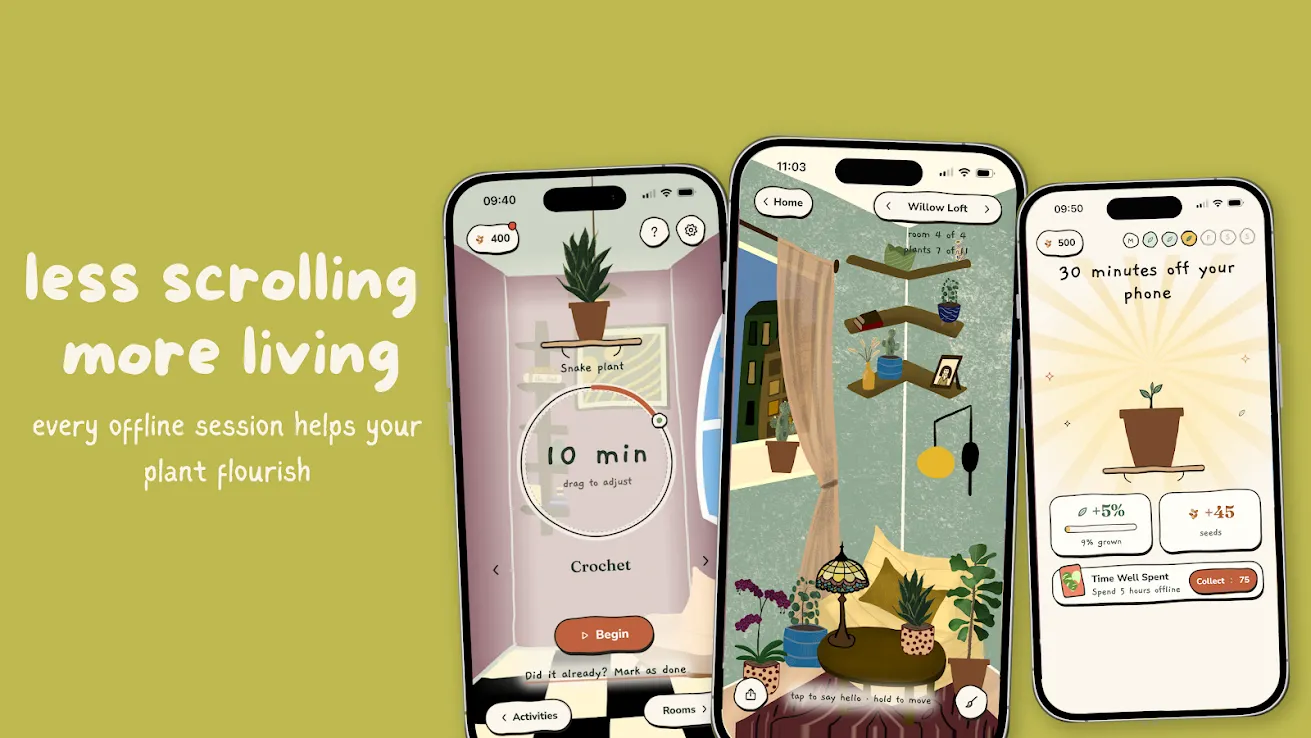
Be Analog is an app designed to help you spend less time mindlessly scrolling and more time doing the things you love offline. It encourages you to make room for your hobbies, create screen-free moments, and build a more intentional relationship with your phone.
Instead of focusing only on what you’re trying to avoid, it gives you something positive to work towards: more time for yourself and the things that make you happy.
Download Be Analog for free: https://play.google.com/store/apps/details?id=com.sokkio.beanalog
Step 6: Learn to embrace boredom (yes, really!)
When was the last time you were bored without immediately reaching for your phone?
Think about it. Waiting for the bus? Phone. Standing in a queue? Phone. Eating lunch alone? Phone. Have five minutes between tasks? Phone.
We’ve become so accustomed to filling every spare moment with digital stimulation that simply doing nothing can feel uncomfortable. But boredom isn’t necessarily something we need to avoid.
In fact, allowing yourself to experience boredom can create opportunities for reflection, daydreaming, and curiosity. When you’re not constantly consuming information, your mind has more space to wander and come up with creative ideas and solutions.
So, what can you do about it? The next time you feel the urge to reach for your phone, try waiting a few minutes. Let yourself be bored. Look around, observe what’s happening, think about something, or simply enjoy a quiet moment.
Go for a walk without listening to a podcast. Have your morning coffee without scrolling through social media. Sit with your thoughts for a while. You don’t have to turn every spare moment into a productive one. Sometimes it’s perfectly fine to do absolutely nothing.
Don’t aim for perfection
One last thing: don’t expect yourself to get everything right from day one.
You might find yourself scrolling for an hour even though you intended to read a book. You might forget your rules after a stressful day. Or you might discover that some of the boundaries you set are too restrictive. That’s okay.
A digital detox doesn’t have to be an all-or-nothing experience. Instead of judging yourself for spending more time on your phone than you intended, pay attention to what happened.
Were you tired? Bored? Avoiding something? Did you have nothing else planned? Understanding these moments can help you adjust your approach and find routines that work better for you.
And remember: the goal isn’t necessarily to use your phone as little as possible. It’s to feel more in control of how you use it.
Final thoughts: Make room for more of what you love
You don’t need to throw away your smartphone, delete every social media account, or spend an entire month offline to make a difference.
You can start small. Understand your habits, set a few boundaries, allow yourself to experience boredom, and find little ways to reconnect with the things you enjoy.
The most important question isn’t just how much time you spend on your phone. It’s what you’d like to do with that time instead.
Maybe it’s finally picking up that book you’ve been meaning to read. Maybe it’s learning a new hobby, spending more time outside, or simply enjoying a quiet morning without immediately checking your notifications.
Whatever it is, make room for it. Life shouldn’t just be about trying to spend less time on your phone. It should be about having more time for the things that make life interesting in the first place.

Frequently Asked Questions
What is a digital detox?
A digital detox is a period of intentionally reducing or taking a break from using digital devices, apps, or online activities. The goal is to become more mindful of your screen time, reduce unwanted digital distractions, and create more opportunities for offline activities.
How long should a digital detox last?
There’s no universally established ideal duration. You can start with an hour, a day, or a weekend and gradually experiment with longer periods. What matters most is finding an approach that feels realistic and helps you develop healthier digital habits.
What are the benefits of a digital detox?
A digital detox can help you become more aware of your screen time, reduce unwanted distractions, and create more opportunities to focus on offline activities. Research has also found some positive effects on psychological well-being, although results vary between individuals and studies.
What should I do instead of scrolling on my phone?
There are plenty of things you can do instead of scrolling. Try reading, drawing, knitting, doing puzzles, journaling, gardening, cooking, or going for a walk. You could also use the extra time to explore a new hobby or reconnect with an old one.